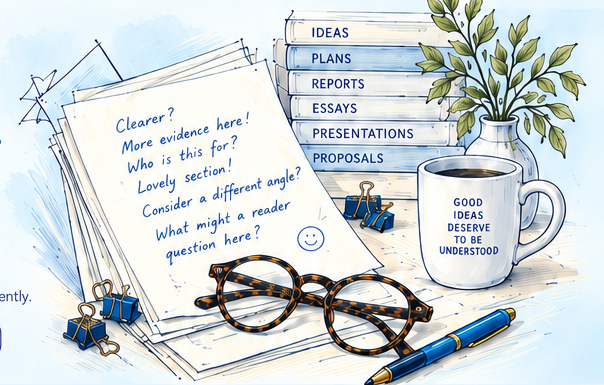
What I may examine.
The work is considered as a whole.
These areas give the examination structure, but they are not a mechanical checklist. The emphasis changes with the material, its audience, its purpose, and the agreed scope.
01Clarity.
I consider what the material actually communicates and where its meaning becomes uncertain, incomplete, or open to different interpretations.
02Purpose and audience.
I consider whether the work supports what it is trying to achieve and whether its intended audience has the context needed to understand it.
03Assumptions.
I identify what the reasoning takes for granted and what must be true for a proposal, conclusion, or recommendation to hold.
04Internal consistency.
I consider whether the claims, choices, and sections support one another, or whether different parts of the work are in tension.
05Context and evidence.
I distinguish between what the submitted material supports, what it leaves unexplained, and what would require further evidence. This is not independent fact checking.
06Alternatives and implications.
I consider other interpretations, possible approaches, and consequences that may deserve attention before the work is used.
07Priorities.
I distinguish central concerns from smaller observations so that the feedback does not treat every issue as equally important.
08What already works.
A review can also identify a useful sentence, a clear connection, or a part of the reasoning that should be protected rather than changed.