A reviewer question.
What information is missing that would help the reader understand both the nature of the divisions and why the council believes regular gatherings will address them?

Example review.
This demonstration shows how I might examine a short fictional paragraph. It is an example of the attention used in an independent review. It is not a fixed template that every review must follow.
The material.
Several residents said they wanted more opportunities to meet one another. The council therefore introduced a monthly community evening. Regular gatherings will eliminate the divisions that have developed over the years.
The first two sentences establish a reason for the council's action. Residents wanted more opportunities to meet, and the council responded by creating one. The word therefore makes that relationship explicit.
The closing sentence works differently. It says that regular gatherings will eliminate divisions, but the paragraph has not yet identified those divisions, explained how they developed, or established why the gatherings would eliminate them.
The reader must supply part of the reasoning while the writer presents the outcome as certain.
The reasoning shift.
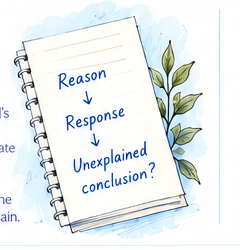
A simple map can make the change visible without rewriting the paragraph.
The paragraph clearly explains why the event was introduced. It does not yet establish why the event will eliminate divisions.
What the reader has to supply.
The paragraph tells the reader that residents wanted more opportunities to meet and that the council responded by organising a monthly event. It does not establish the premise that those gatherings will address the divisions mentioned in the final sentence.
The reader is therefore asked to accept a conclusion without being shown every step needed to reach it.
In rhetorical analysis, a conclusion that depends on a premise that is not fully stated can be described as an enthymeme. The term is useful, but the review does not require a client to know it. The practical issue is that the reader has to supply part of the logic.
Because the paragraph does not define the divisions or explain their relationship to the gatherings, readers may supply their own assumptions in order to make the conclusion coherent.
One reader may imagine social isolation. Another may imagine political disagreement, cultural conflict, or longstanding personal tensions. The text leaves enough of the reasoning unstated that meaning can be introduced by the reader rather than established by the writer.
The phrase will eliminate presents the outcome as definitive. The paragraph has not yet supplied evidence or reasoning strong enough to justify that degree of certainty. The force of the conclusion therefore comes mainly from the confidence of the wording rather than from reasoning the reader has been shown and can assess.
A more disciplined claim would keep its level of certainty proportionate to what the material has actually established. The review does not decide the wording for the writer. It identifies the mismatch so that the writer can decide whether the claim, the support, or both need further work.
A practical reading would ask what the proposed gatherings can reasonably be expected to accomplish and what evidence could demonstrate that effect. The paragraph moves directly from introducing regular gatherings to declaring the elimination of divisions.
It does not identify the mechanism connecting the two. Explaining what the gatherings change, how that change addresses the stated divisions, and what outcome can reasonably follow would make the conclusion easier for the reader to evaluate.
What information is missing that would help the reader understand both the nature of the divisions and why the council believes regular gatherings will address them?
The opening sentence should remain. It gives the residents a voice and establishes the need to which the council responds. Without it, the community evening becomes an action without a clearly stated reason.
A review can identify what should be protected as well as what deserves another look.
What happens next.
This example surfaces a reasoning gap, an interpretive risk, a change in certainty, a practical question, and a sentence worth protecting. It does not prescribe a complete rewrite.
The writer decides whether the observations matter and what, if anything, to change. That distinction is central to the service.